
[Film Review] Return to Silent Hill (2026)

The life of a Silent Hill fan is a turbulent one. For every Silent Hill 3, there’s a Silent Hill: Homecoming. For every Silent Hill 2 Remake, there’s a Silent Hill: Ascension. For every Silent Hill f, there’s a Return to Silent Hill, and thus, the pendulum continues to swing, this time into frustrating - but expected - disappointment.
Christophe Gans’ return to the famous foggy nightmare town comes 20 years after his first Silent Hill adaptation, which remains, unfortunately, many people’s introduction to the iconic survival horror game series. Billed as an adaptation of 2001’s Silent Hill 2, Return to Silent Hill follows James Sunderland (Jeremy Irvine), a troubled man mourning the loss of his true love Mary (Hannah Emily Anderson), who receives a mysterious letter pleading with him to come back to the town of Silent Hill. Upon arriving, James finds the quaint little lakeside resort of his memories abandoned, derelict and full of grotesque monsters that he will have to defeat to learn the truth behind the letter, and why he had to come back.
If you haven’t played Silent Hill 2 and are worried you’ll be confused by what’s happening on screen, fear not – because Gans apparently hasn’t played the game either. Despite promising that Return to Silent Hill would be a “faithful” adaptation of Konami’s iconic psychological horror game, this is a film that demonstrates a profound misunderstanding of its source material in both plot and tone.
What made Silent Hill 2 so scary, and still so revered 25 years after release, was the game’s focus on atmosphere, trading the gore and carnage popularized by the Resident Evil trend at the time for slow, subtle scares that build over the course of a runthrough. Most critically, this is demonstrated in James’ descent into both the darkness of the town and the darkness that lurks in his mind. Our first introduction to James makes it obvious that he is an everyman, exhausted and confused, sure, but otherwise completely nondescript. The game takes its time in unravelling his sanity, as small cracks in his demeanour begin to hint that something is not quite right with him, or the story he’s been telling.
Admittedly, it’s not easy to demonstrate such a gradual change over the relatively short amount of time allocated to any motion picture, but it doesn’t help that when we meet the James of Return to Silent Hill, he is already a cartoonish mockery of a ‘tortured artist’-- complete with leather jacket, joint, and Jim Morrison haircut. Stock hard rock music punctuates a laughably pronounced product placement for Ford Mustang as James speeds into Silent Hill, quickly eliminating any tension as he encounters emaciated monsters he could easily take in a bar fight.
Said monsters don’t fare much better either – while Gans’ Silent Hill wasn’t perfect by any means, it at least did a pretty solid job of adapting the shuffling, shambling gait of the Lying Figures, armless humanoid abominations that have become one of the series’ flagship symbols. Somehow, they look even worse in Return to Silent Hill than they did when rendered with the technology of the early 2000s. Admittedly, Return to Silent Hill was working with a far lower budget, but Gans’ claims that minimal CGI was used in bringing the monsters to life feels, frankly, insulting to anyone with eyes.
Return to Silent Hill also fails at its most basic expectation of making the titular town even the least bit scary. Flat, lifeless and ugly, every scene is devoid of tangible texture, because while Irvine tries his best with the weak material afforded him, he is clearly performing against a green screen for the majority of the film, leaving his performance weightless and directionless. There’s never a sense that James is in any real danger, just as there is never a sense he is actually walking down a real high street with shop fronts and buildings.
Just as weightless as the visuals is Return to Silent Hill’s story. There’s nothing inherently wrong with changing a game for ease of adaptation; in fact, as most games run far longer, it’s often a wise choice not to try and cram every single element of gameplay into a 90 to 120 minute movie. However, rather than trim down Silent Hill 2’s relatively straightforward plot, Return to Silent Hill, in the short span of 106 minutes, makes the baffling choice to cram in an entirely ‘original’ subplot (although pulled almost wholesale from other games in the Silent Hill series) that diminishes the melancholy of the original story by stripping away its quiet simplicity. James is no longer a lost, lonely man on a mission to reunite with his love, but a man swept up in something much bigger – something that Return to Silent Hill has neither the script nor skill to imbue with any real stakes. Presumable moments of importance are never allowed to settle or sit before the next set piece is rushed in to meet a quota of recognizability, meaning viewers stand little chance of absorbing any of the new story additions, even if they cared to.
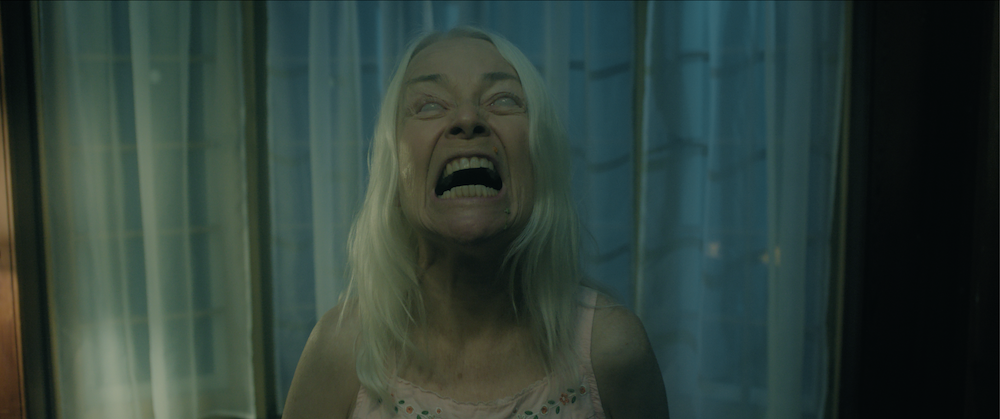
As it did in Silent Hill and Silent Hill: Revelation, Akira Yamaoka’s iconic score does a lot of heavy lifting when it comes to establishing even a touch of atmosphere, but the most famous tracks feel shoehorned in as an attempt to hit those nostalgia cues, cues that your average, non-Silent Hill nerd viewer isn’t going to understand. It begs the question – who is the intended audience for Return to Silent Hill? Fans of the original Silent Hill 2 are a notoriously protective bunch and tough to please, but newcomers will just feel as lost as James in the fog when lore is assumed and characters are introduced with a wink-wink-nudge-nudge nod to gamers and no further development. Even Pyramid Head, who has escaped franchise containment to become an instantly recognisable symbol of the Silent Hill world, doesn’t live up to expectations, reduced from silent, behemothic executioner into raging, grunting ‘roided up background noise, an irritation more than anything else.
A mess on all fronts and an insult to its source material, Return to Silent Hill does absolutely nothing to refute the notion that video games cannot be adapted into film form successfully. Let’s hope Zach Cregger’s Resident Evil fares better this summer.

![[Film Review] The Convenience Store (2026)](https://images.squarespace-cdn.com/content/v1/5fe76a518d20536a3fbd7246/1772706929814-S9SCNO48X7OAAUXDGW6Z/%5Bmain%5DDSC07956+%281%29.jpg)
![[Film Review] Red Riding (2026)](https://images.squarespace-cdn.com/content/v1/5fe76a518d20536a3fbd7246/1772815841313-70WFC6UZR8R3D8K1QQNB/Red_Riding_MASTER_310725_4KDCI_PRORES4444.00_07_53_05.Still012.png)
![[Film Review] Queens of the Dead (2025)](https://images.squarespace-cdn.com/content/v1/5fe76a518d20536a3fbd7246/1772708277363-T21QMHC11OQWUEWE9JRA/Queens+of+the+Dead+%281%29.jpg)
![[Film Review] Bury the Devil (2026)](https://images.squarespace-cdn.com/content/v1/5fe76a518d20536a3fbd7246/1772707319010-7HUFW2VLHJ5RKZ3EH8C4/Bury+the+Devil_1.png)

Redux Redux comes to streaming off the back of a fair amount of hype after playing several festivals, including South by Southwest, where it had its premiere as part of their Midnighter strand last year. Festival hype is, of course, always to be taken with a grain of salt, but in the case of Redux Redux, it feels very warranted.