
[Film Review] As Above, So Below (2014)
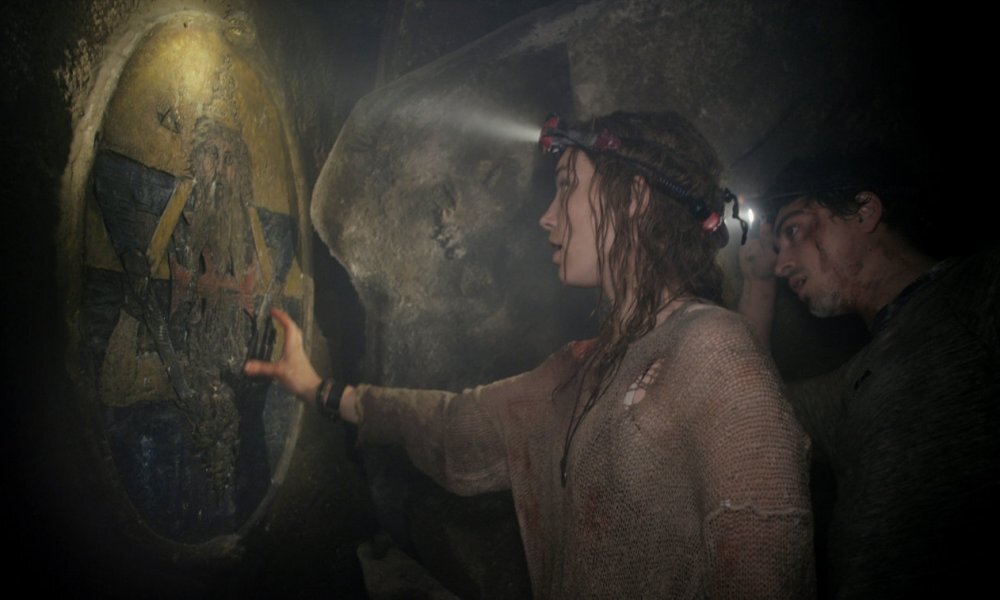
Claustrophobia is a popular fear to explore in horror movies. Filmmakers use tools like limited locations and tight shots to establish a sense of boxed-in dread. As Above, So Below (2014) takes this conceit a step further. Not only does director John Erick Dowdle’s ambitious found footage film explore physical claustrophobia; it explores spiritual claustrophobia as well. The film’s characters literally descend into Hell to face the guilt and fear that suffocate them in their daily lives. “As above, so below, as within, so without, as the universe, so the soul.” Combining elements from Tomb Raider and The Descent with Dante’s Inferno, As Above, So Below is a striking and unique film that cleverly exemplifies its title by finding the horror within this claustrophobia of the soul.
Scarlett (Perdita Weeks) is an archaeologist attempting to finish her late father’s work and find the fabled Philosopher’s Stone, a legendary alchemical treasure rumoured to hold the key to eternal life. Benji (Edwin Hodge) is a documentarian following Scarlett’s journey to track down the Stone. With the help of her friend George (Ben Feldman), Scarlett discovers that the Stone is hidden within the Paris Catacombs. They enlist local experts Papillon (François Civil), Souxie (Marion Lambert), and Zed (Ali Marhyar) to guide them through the restricted portion of the Catacombs. As the explorers descend into the bowels of the Catacombs, running into impossible dead ends and discovering that they are hopelessly lost, they pass through the gates of Hell and encounter their own personal demons. Only those who face the truth and admit their feelings of guilt survive the odyssey.
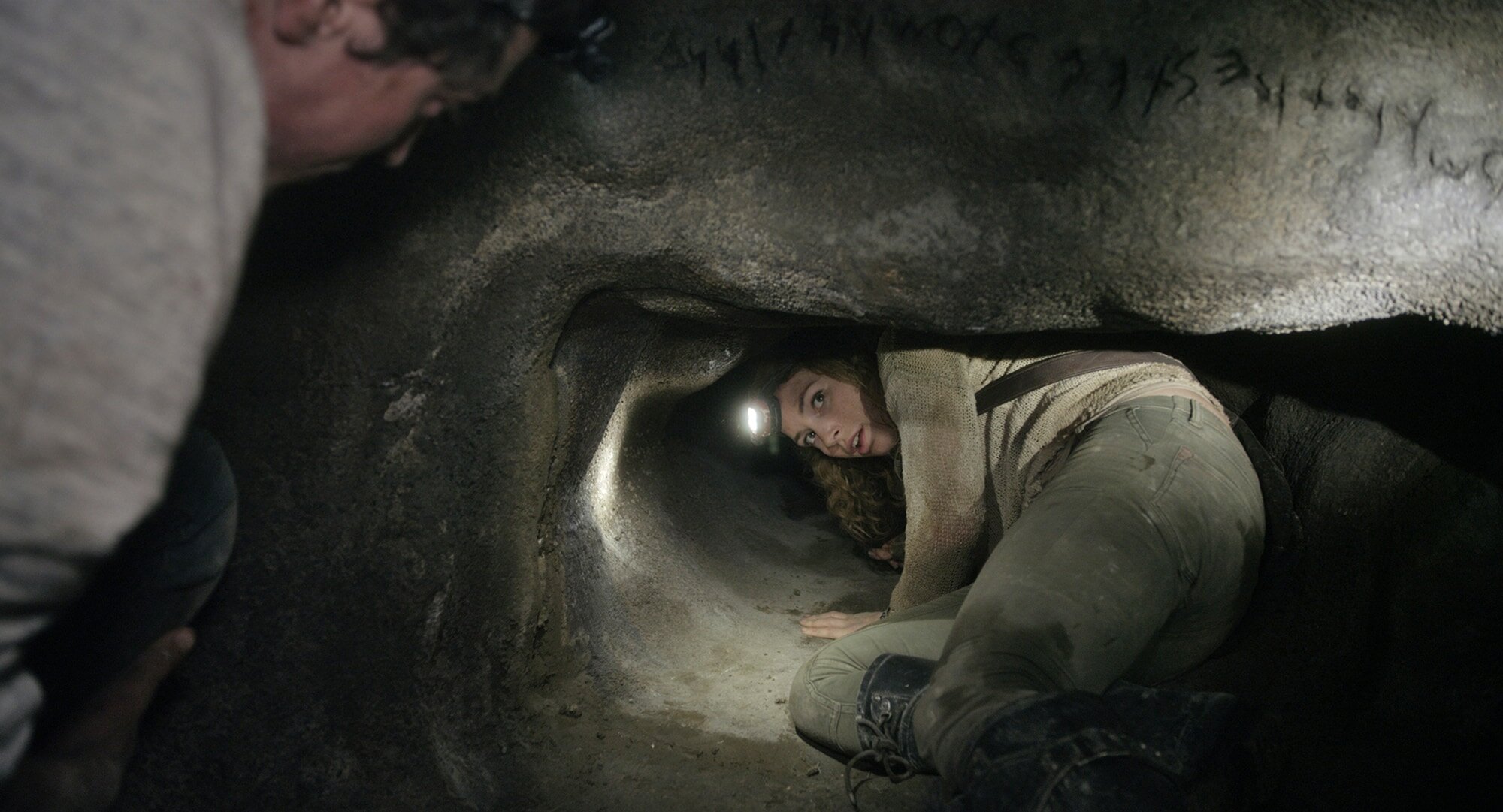
As Above, So Below is an eclectic mix of genres and subgenres: religious horror, found footage, survival thriller, adventure, mystery, and psychological horror. It’s an intriguing mélange that is impressively cohesive and inventive, though the parallels between the film and 2005’s The Descent are impossible to ignore. In both films, the characters explore underground caverns where they don’t belong, braving cave-ins and madness as they delve deeper into their own guilt and grief. The two films even share scenes of characters crawling frantically over mounds of human bones. Though a film could do a lot worse than being compared to the masterpiece that is The Descent, As Above, So Below transcends this comparison with its unique vision and eerie setting.
Filming took place in the actual Paris Catacombs, and that authenticity shines through both in the film’s atmosphere and its performances. The camaraderie amongst the Parisian guides is palpable, as is the chemistry between Scarlett and George, who clearly have an unresolved romantic history. The already strong cast reaches new heights of fear and paranoia once they start wandering through cursed tunnels lined with real skeletal remains. Their mounting anxiety elicits the same response in the viewer. It’s a brilliant setting for a horror movie, combining the claustrophobia of a cave with the oppressive eeriness of a graveyard. As Above, So Below wisely lets its location do a lot of the heavy lifting in terms of scares; though strategically placed props provide disturbing moments of fright, the Catacombs themselves are terrifying enough on their own.
The choice to tell the story via the style of found footage enhances the terror. The film initially unfolds through the lens of Benji’s camera. As the group treks through the underground ossuary, the film’s point of view expands to other members of the spelunking crew via their helmet cams. As Above, So Below makes canny use of the marvellous contradiction inherent within the Catacombs. They are a massive underground system constructed of uncomfortably tight tunnels that seem to swallow light. The huge scale of the Catacombs contrasted with the claustrophobia of trying to navigate them causes a funhouse distortion that cleverly ties in with the group’s attempt to escape Hell, particularly the eye-catching final scene of the film.

Despite its many strengths, As Above, So Below is not a perfect film. There are moments of narrative silliness, such as when George translates a passage from Aramaic and miraculously finds that it rhymes in English. More troubling is a moment of Islamophobia at the beginning of the film. Scarlett is in Iran searching for clues to the location of the Philosopher’s Stone. She is trying to get into a hidden location moments before it is blown up by local authorities, and as she puzzles over the problem she throws off the hijab she’s wearing and exclaims, “I can’t think with this thing on my head!” It’s a regrettable moment that serves no purpose beyond making the viewer doubt Scarlett’s respect for cultures different to her own. As with many films about archaeological adventures, the lead character is often quite cavalier in her treatment of artifacts and sacred sites, but this seemingly offhand remark feels egregious even within a genre where the heroes are willing to ignore cultural mores and destroy historical treasures to achieve their personal goals.
Still, As Above, So Below is a memorable horror story that deserves a place among the best found footage films. With strong performances and eerie imagery, this ambitious film plays with genre in intriguing ways and rewards multiple viewings. It explores the terror within and the terror without, proving that claustrophobia is a universal fear no matter how you experience it. Whether they are the literal walls of a tunnel, or the walls of your own mind as you battle guilt and sorrow, one thing remains true: they are closing in on you, and escape is never assured.







RELATED ARTICLES

![[Film Review] Redux Redux (2025)](https://images.squarespace-cdn.com/content/v1/5fe76a518d20536a3fbd7246/1772709237214-NWJO8S5RA2RI5KHGBDRP/Redux+Redux+%28Blue+Finch+Film+Releasing%29+%2801%29.jpg)
![[Film Review] The Convenience Store (2026)](https://images.squarespace-cdn.com/content/v1/5fe76a518d20536a3fbd7246/1772706929814-S9SCNO48X7OAAUXDGW6Z/%5Bmain%5DDSC07956+%281%29.jpg)
![[Film Review] Red Riding (2026)](https://images.squarespace-cdn.com/content/v1/5fe76a518d20536a3fbd7246/1772815841313-70WFC6UZR8R3D8K1QQNB/Red_Riding_MASTER_310725_4KDCI_PRORES4444.00_07_53_05.Still012.png)
![[Film Review] Queens of the Dead (2025)](https://images.squarespace-cdn.com/content/v1/5fe76a518d20536a3fbd7246/1772708277363-T21QMHC11OQWUEWE9JRA/Queens+of+the+Dead+%281%29.jpg)
![[Film Review] Bury the Devil (2026)](https://images.squarespace-cdn.com/content/v1/5fe76a518d20536a3fbd7246/1772707319010-7HUFW2VLHJ5RKZ3EH8C4/Bury+the+Devil_1.png)
![[Film Review] Jailbroken (2026)](https://images.squarespace-cdn.com/content/v1/5fe76a518d20536a3fbd7246/1771753986825-4CM6ZCTLWAZYUGB1IBMP/Jailbroken+%C2%A9+2026+Jailbroken+Film%2C+Ltd.+All+Rights+Reserved.jpg)
![[Film Review] Iron Lung (2026)](https://images.squarespace-cdn.com/content/v1/5fe76a518d20536a3fbd7246/1772663006181-UCSTWEIJZBJRNR97BJR9/Screenshot+2026-03-04+at+22.10.26.png)
GHOULS GANG CONTENT



EXPLORE
![[Book Review] Tradwife (2026)](https://images.squarespace-cdn.com/content/v1/5fe76a518d20536a3fbd7246/1772486876449-UAV7VIO5G32H0EKC2Y1B/Trad+Wife+HB.jpg)
![[Book Review] The Book of Queer Saints Volume II (2023)](https://images.squarespace-cdn.com/content/v1/5fe76a518d20536a3fbd7246/1697187383073-U78VOF5WVDHI9YE8M98A/Screenshot+2023-10-13+at+09.52.31.png)
![[Book Review] Wylding Hall (2015)](https://images.squarespace-cdn.com/content/v1/5fe76a518d20536a3fbd7246/1695484930026-PFRK7O26SLME4JIC49EW/Screenshot+2023-09-23+at+16.59.04.png)
![[Book Review] Penance (2023) by Eliza Clark](https://images.squarespace-cdn.com/content/v1/5fe76a518d20536a3fbd7246/1695481011772-L4DNTNPSHLG2BQ69CZC1/Screenshot+2023-09-23+at+15.54.07.png)
![[Book Review] The Exorcist Legacy: 50 Years of Fear](https://images.squarespace-cdn.com/content/v1/5fe76a518d20536a3fbd7246/1691328003764-IASXC6UJB2B3JCDQUVGP/61q9oHE0ddL._AC_UF1000%2C1000_QL80_.jpg)
![[Book Review] Nineteen Claws And A Black Bird (2020)](https://images.squarespace-cdn.com/content/v1/5fe76a518d20536a3fbd7246/1685872305328-UE9QXAELX0P9YLROCOJU/62919399._UY630_SR1200%2C630_.jpg)
![[Book Review] Manhunt (2022)](https://images.squarespace-cdn.com/content/v1/5fe76a518d20536a3fbd7246/1683911513884-1Q1IGIU9O5X5BTLBXHV9/53329296._UY630_SR1200%2C630_.jpg)
![[Book Review] Eyes Guts Throat Bones (2023)](https://images.squarespace-cdn.com/content/v1/5fe76a518d20536a3fbd7246/1682344253308-4AAFX12YD84EVJBYNJBZ/7e617654-8d9e-407e-8cde-33a97df84dcf.__CR0%2C0%2C970%2C600_PT0_SX970_V1___.jpg)

![[Editorial] 9 Essential Hagspolitation Horror Films and Where to Stream Them](https://images.squarespace-cdn.com/content/v1/5fe76a518d20536a3fbd7246/1770475320934-ABFCNG7QZCG95DHZW2TH/Hagsploitation+list.jpeg)
![[Editorial] 7 Valentine's Day films for the horror lover in your life](https://images.squarespace-cdn.com/content/v1/5fe76a518d20536a3fbd7246/1771008023919-TKX6A1Y1GKGQ20ONPNYD/nekromantik.jpg)
![[Editorial] Seven Horror Hits That Haunted Our Hiatus](https://images.squarespace-cdn.com/content/v1/5fe76a518d20536a3fbd7246/1769674801188-7W482NENPO0GN4CDHV5N/7+HORROR+HITS+HIATUS.webp)
![[Editorial] Oscar Nominations 2026: Where to stream all the horror picks](https://images.squarespace-cdn.com/content/v1/5fe76a518d20536a3fbd7246/1769113319180-4INRRNMZK4DZLHRSUXX5/rev-1-GRC-TT-0026r_High_Res_JPEG-1024x372.jpeg)
![[Editorial] 10 Films & Events to Catch at Soho Horror Film Fest 2023](https://images.squarespace-cdn.com/content/v1/5fe76a518d20536a3fbd7246/1700819417135-299R7L4P0B676AD3RO1X/Screenshot+2023-11-24+at+09.41.52.png)
![[Editorial] 9 Horror Nintendo Switch Games To Play](https://images.squarespace-cdn.com/content/v1/5fe76a518d20536a3fbd7246/1697214470057-3XZXX8N4LYIMDFWS6Z3P/Screenshot+2023-10-13+at+17.20.13.png)
![[Mother of Fears] Mothering in Silence in A Quiet Place (2018)](https://images.squarespace-cdn.com/content/v1/5fe76a518d20536a3fbd7246/1696445921315-HZJ2DZYQIH6VVWXBO2YL/Screenshot+2023-10-04+at+19.52.29.png)
![[Editorial] “I control my life, not you!”: Living with Generalised Anxiety Disorder and the catharsis of the Final Destination franchise](https://images.squarespace-cdn.com/content/v1/5fe76a518d20536a3fbd7246/1696444478023-O3UXJCSZ4STJOH61TKNG/Screenshot+2023-10-04+at+19.30.37.png)
![[Editorial] 5 Female Focused Horror Book Recommendations](https://images.squarespace-cdn.com/content/v1/5fe76a518d20536a3fbd7246/1696441981361-52EQCTJ7AT2QF1927GM7/919xtm6d3fL._AC_UF894%2C1000_QL80_.jpg)
![[Editorial] 5 Slasher Short Horror Films](https://images.squarespace-cdn.com/content/v1/5fe76a518d20536a3fbd7246/1696358009946-N8MEV989O1PAHUYYMAWK/Screenshot+2023-10-03+at+19.33.19.png)


You've now found the staple t-shirt of your wardrobe. It's made of a thicker, heavier cotton, but it's still soft and comfy. And the double stitching on the neckline and sleeves add more durability to what is sure to be a favourite!
• 100% ring-spun cotton
• Sport Grey is 90% ring-spun cotton, 10% polyester
• Dark Heather is 65% polyester, 35% cotton
• 4.5 oz/y² (153 g/m²)
• Pre-shrunk
• Shoulder-to-shoulder taping
• Quarter-turned to avoid crease down the centre
PLEASE NOTE: AT THIS STAGE, ALL OUR PRODUCTS ARE MADE TO ORDER BY OUR SUPPLIERS AS PER YOUR REQUIREMENTS. THEREFORE, WE CANNOT ACCEPT RETURNS UNLESS FAULTY OR INCORRECT. PLEASE SEE OUR FULL POLICY HERE
DELIVERY
UK & EUROPE: 5 - 10 DAYS
USA: 10 - 20 DAYS