
[Book Review] Love Sickness (2021)
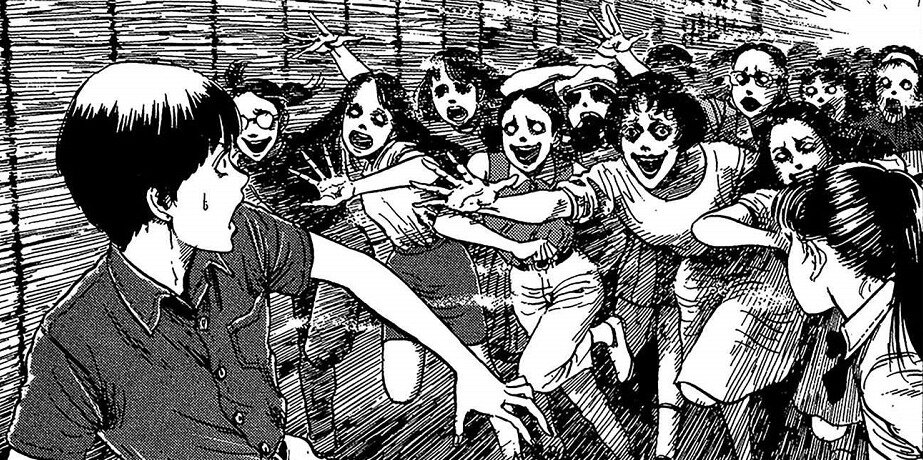
Lovesickness is one of Junji Ito’s lesser-known titles - Tomie and Uzamaki are the most famous - but Lovesickness certainly rivals them in terms of storytelling. Lovesickness is the collection’s main story, which follows Rysusuke who returns to a town where he had once lived before.
The town is ominous as the people within it are fanatics of “crossroad fortune-telling”. This is where an individual must stand at an intersection and wait for the first passerby to tell them their fortune. One day a “beautiful boy dressed in all black clothing, with a pierced ear”, known as the boy in black, begins to maliciously tell the young women of the town bad fortunes.
The young women quickly become obsessed with the boy in black: each wants to fulfil his twisted fortunes. He turns friends against friends, leads a woman to kill her lover’s son and set herself ablaze, and culminates in the mass suicide of teenage girls. Amidst this chaos, Rysusuke begins patrolling the intersections trying to stop the boy in black from telling fortunes.
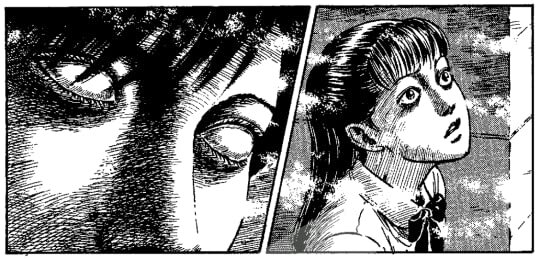
Lovesickness explores being a prisoner of guilt. Although Rysusuke appears very sweet natured, readers quickly realize that he harbours a dark secret. During his childhood, a woman committed suicide because he told her a cruel fortune. Harbouring guilt for the women’s death, Rysusuke patrols the intersections to prevent further suicide. Would Ryusuke be as obsessed with finding the boy in black if he did not want to right his own wrongs? Lovesickness also explores the horrors that come with idolatry. The young women lose their sanity because of their idolisation of the boy in black and in the end, they kill themselves because of him. Ito uses sexist tropes to ridicule how the media portray women. The women in Lovesickness always ask about love in their crossroad fortunes as if love is the only thing that is important to them.
Overall, Lovesickness is perhaps not one of Ito’s strongest pieces of work, but has fantastic horror elements, some of which resonate in real life. My second favourite story in the collection is “The Rib Woman”, which focuses on women who surgically remove their rib cages. The story reinforces the horrors of beauty standards that pressure women to change their appearances. There are three other stories within the collection, “The Strange Hikizuri Siblings”, “The Mansion of Phantom Pain” and “Memories of Real Poop”. The latter is my least favourite because of its incorporation of comedy – but some people enjoy the mixture of comedy and horror, so if that is the case, they may like the story. If you are a fan of body horror, grotesque images, and ghost stories, then you may like this collection.
You can purchase Lovesickness here.



RELATED ARTICLES
![[Book Review] Tradwife (2026)](https://images.squarespace-cdn.com/content/v1/5fe76a518d20536a3fbd7246/1772486876449-UAV7VIO5G32H0EKC2Y1B/Trad+Wife+HB.jpg)
![[Book Review] The Book of Queer Saints Volume II (2023)](https://images.squarespace-cdn.com/content/v1/5fe76a518d20536a3fbd7246/1697187383073-U78VOF5WVDHI9YE8M98A/Screenshot+2023-10-13+at+09.52.31.png)
![[Book Review] Wylding Hall (2015)](https://images.squarespace-cdn.com/content/v1/5fe76a518d20536a3fbd7246/1695484930026-PFRK7O26SLME4JIC49EW/Screenshot+2023-09-23+at+16.59.04.png)
![[Book Review] Penance (2023) by Eliza Clark](https://images.squarespace-cdn.com/content/v1/5fe76a518d20536a3fbd7246/1695481011772-L4DNTNPSHLG2BQ69CZC1/Screenshot+2023-09-23+at+15.54.07.png)
![[Book Review] The Exorcist Legacy: 50 Years of Fear](https://images.squarespace-cdn.com/content/v1/5fe76a518d20536a3fbd7246/1691328003764-IASXC6UJB2B3JCDQUVGP/61q9oHE0ddL._AC_UF1000%2C1000_QL80_.jpg)
![[Book Review] Nineteen Claws And A Black Bird (2020)](https://images.squarespace-cdn.com/content/v1/5fe76a518d20536a3fbd7246/1685872305328-UE9QXAELX0P9YLROCOJU/62919399._UY630_SR1200%2C630_.jpg)
![[Book Review] Manhunt (2022)](https://images.squarespace-cdn.com/content/v1/5fe76a518d20536a3fbd7246/1683911513884-1Q1IGIU9O5X5BTLBXHV9/53329296._UY630_SR1200%2C630_.jpg)
![[Book Review] Eyes Guts Throat Bones (2023)](https://images.squarespace-cdn.com/content/v1/5fe76a518d20536a3fbd7246/1682344253308-4AAFX12YD84EVJBYNJBZ/7e617654-8d9e-407e-8cde-33a97df84dcf.__CR0%2C0%2C970%2C600_PT0_SX970_V1___.jpg)
![[Book Review] Cursed Bunny (2017)](https://images.squarespace-cdn.com/content/v1/5fe76a518d20536a3fbd7246/1680266256479-2E2XJT4T8CGAMOUB7XAL/298618053_5552736738082400_5168089788506882676_n.jpg)
![[Book Review] The Aosawa Murders (2020)](https://images.squarespace-cdn.com/content/v1/5fe76a518d20536a3fbd7246/1678009096264-7QOOFO5PI9LAX47L3GF6/51054767.jpg)









EXPLORE
![[Film Review] Redux Redux (2025)](https://images.squarespace-cdn.com/content/v1/5fe76a518d20536a3fbd7246/1772709237214-NWJO8S5RA2RI5KHGBDRP/Redux+Redux+%28Blue+Finch+Film+Releasing%29+%2801%29.jpg)
![[Film Review] The Convenience Store (2026)](https://images.squarespace-cdn.com/content/v1/5fe76a518d20536a3fbd7246/1772706929814-S9SCNO48X7OAAUXDGW6Z/%5Bmain%5DDSC07956+%281%29.jpg)
![[Film Review] Red Riding (2026)](https://images.squarespace-cdn.com/content/v1/5fe76a518d20536a3fbd7246/1772815841313-70WFC6UZR8R3D8K1QQNB/Red_Riding_MASTER_310725_4KDCI_PRORES4444.00_07_53_05.Still012.png)
![[Film Review] Queens of the Dead (2025)](https://images.squarespace-cdn.com/content/v1/5fe76a518d20536a3fbd7246/1772708277363-T21QMHC11OQWUEWE9JRA/Queens+of+the+Dead+%281%29.jpg)
![[Film Review] Bury the Devil (2026)](https://images.squarespace-cdn.com/content/v1/5fe76a518d20536a3fbd7246/1772707319010-7HUFW2VLHJ5RKZ3EH8C4/Bury+the+Devil_1.png)
![[Film Review] Jailbroken (2026)](https://images.squarespace-cdn.com/content/v1/5fe76a518d20536a3fbd7246/1771753986825-4CM6ZCTLWAZYUGB1IBMP/Jailbroken+%C2%A9+2026+Jailbroken+Film%2C+Ltd.+All+Rights+Reserved.jpg)
![[Film Review] Iron Lung (2026)](https://images.squarespace-cdn.com/content/v1/5fe76a518d20536a3fbd7246/1772663006181-UCSTWEIJZBJRNR97BJR9/Screenshot+2026-03-04+at+22.10.26.png)

![[Editorial] 9 Essential Hagspolitation Horror Films and Where to Stream Them](https://images.squarespace-cdn.com/content/v1/5fe76a518d20536a3fbd7246/1770475320934-ABFCNG7QZCG95DHZW2TH/Hagsploitation+list.jpeg)
![[Editorial] 7 Valentine's Day films for the horror lover in your life](https://images.squarespace-cdn.com/content/v1/5fe76a518d20536a3fbd7246/1771008023919-TKX6A1Y1GKGQ20ONPNYD/nekromantik.jpg)
![[Editorial] Seven Horror Hits That Haunted Our Hiatus](https://images.squarespace-cdn.com/content/v1/5fe76a518d20536a3fbd7246/1769674801188-7W482NENPO0GN4CDHV5N/7+HORROR+HITS+HIATUS.webp)
![[Editorial] Oscar Nominations 2026: Where to stream all the horror picks](https://images.squarespace-cdn.com/content/v1/5fe76a518d20536a3fbd7246/1769113319180-4INRRNMZK4DZLHRSUXX5/rev-1-GRC-TT-0026r_High_Res_JPEG-1024x372.jpeg)
![[Editorial] 10 Films & Events to Catch at Soho Horror Film Fest 2023](https://images.squarespace-cdn.com/content/v1/5fe76a518d20536a3fbd7246/1700819417135-299R7L4P0B676AD3RO1X/Screenshot+2023-11-24+at+09.41.52.png)
![[Editorial] 9 Horror Nintendo Switch Games To Play](https://images.squarespace-cdn.com/content/v1/5fe76a518d20536a3fbd7246/1697214470057-3XZXX8N4LYIMDFWS6Z3P/Screenshot+2023-10-13+at+17.20.13.png)
![[Mother of Fears] Mothering in Silence in A Quiet Place (2018)](https://images.squarespace-cdn.com/content/v1/5fe76a518d20536a3fbd7246/1696445921315-HZJ2DZYQIH6VVWXBO2YL/Screenshot+2023-10-04+at+19.52.29.png)
![[Editorial] “I control my life, not you!”: Living with Generalised Anxiety Disorder and the catharsis of the Final Destination franchise](https://images.squarespace-cdn.com/content/v1/5fe76a518d20536a3fbd7246/1696444478023-O3UXJCSZ4STJOH61TKNG/Screenshot+2023-10-04+at+19.30.37.png)
![[Editorial] 5 Female Focused Horror Book Recommendations](https://images.squarespace-cdn.com/content/v1/5fe76a518d20536a3fbd7246/1696441981361-52EQCTJ7AT2QF1927GM7/919xtm6d3fL._AC_UF894%2C1000_QL80_.jpg)
![[Editorial] 5 Slasher Short Horror Films](https://images.squarespace-cdn.com/content/v1/5fe76a518d20536a3fbd7246/1696358009946-N8MEV989O1PAHUYYMAWK/Screenshot+2023-10-03+at+19.33.19.png)

Quisque iaculis facilisis lacinia. Mauris euismod pellentesque tellus sit amet mollis.