
[Book Review] Night Rooms (2021)
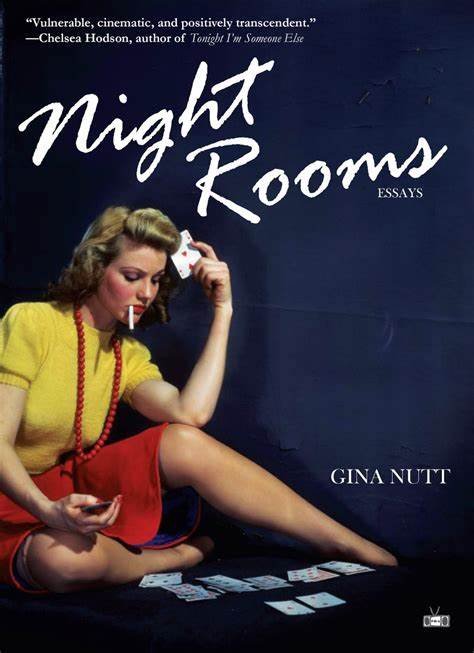
In Gina Nutt's essay collection Night Rooms (2021), she artfully connects horror movies, horror books and the infamous "final girl" trope to events from her own life. She is a published poet, and her prose blooms as she vividly describes both what she's seen on screen and what she's seen in real life.
After a plumbing mishap (a modern-day horror if there ever was one), she says, "Hair-thin tree roots had grown through the pipes, feeding on the waste and water being carried from the house. The roots had backed water up into the washer as they thrived, thick as the thumbs of the men who came to cut up the sidewalk." While it's not what a horror fan typically thinks of when they hear "home invasion," the concept is there. Her house, her safe space, is invaded by mysterious outsiders that wreak havoc. Plumbing issues are banal, but Nutt imbues them with color and feeling. She brings the nightmare to life.
When Nutt was searching for a home, the experience was complicated by her vast knowledge of movies, TV shows and books about haunted houses. She discovers a website where one can pay for a report that lists the deaths that have occurred in a home. In the end, she doesn't buy the report, saying, "I tell myself I don't want to pay for the information. The truth is I'm too afraid to know."
Given her love for and encyclopedic knowledge of scary movies, one can hardly blame her for avoiding this disturbing information. Nutt calls horror movies "contained catastrophes," but if her own home were a place where deaths (especially violent deaths) occurred, the catastrophe is not at all contained; it would be a long-lasting nightmare. While she may appreciate haunted house films like Beetlejuice and Poltergeist, the possibility of a haunting in her own home isn't a can of worms she wants to open.
Nutt also mixes the story of a painful problem with her IUD, her memories of being a young ballerina, feelings of body dysmorphia and body horror, and moments from the classic giallo film Suspiria (as well as its 2018 remake). Has there ever been a more upsettingly perfect combination of female pain?
When Nutt's tattoo artist warns that her tattoo will stretch out when she has kids, she tells him that she doesn't want any. He informs Nutt, an adult woman, "Every girl says that." Later, Nutt chooses an IUD as her birth control method, but it shifts painfully inside of her. After the device is removed, she says, "I wanted another, even though I know it could happen again." In a world where women don't always have control over their lives (or increasingly, their own bodies), she knows she can at least control her chances of getting pregnant – she can control this particular body horror, even if it's painful.
A dance instructor implies that a young leotard-clad Nutt has a weight problem, telling her, "I can see your lunch." Nutt takes her own experience with this cruel teacher and swiftly connects it with the dancers from both Suspiria films. At the witch-run school, the dancers are often treated with contempt by their instructors, even as they push their bodies to the limit in the name of dance. Nutt describes a harrowing scene from the Suspiria remake: A ballerina "twists and bends until her bones break" when she is "beguiled by an unseen force."
The interdependent concepts of body horror and losing control over one's own body echo throughout Nutt's collection. As a teenager, Nutt self-harmed and experienced disordered eating, which culminated in a hospital stay. After confiding in a friend, rumors about Nutt spread, and she is bullied and threatened by her classmates. She thinks of Stephen King's titular Carrie, who also contends with the cruelty of her classmates. Carrie's feelings are so strong that she develops telekinesis with the onset of her first period. After a particularly devastating prank, she takes a very bloody revenge on her classmates.
Unlike Carrie, however, Nutt internalized her feelings (as many real-life teens do), trying to control what little she can by altering her body. She references Teeth and The Last House on the Left, which are both rape revenge stories, but ultimately, she says, "Revenge narratives often rely on someone harmed becoming as monstrous and violent as the person who harmed them. I am too soft to obliterate a tender self in favor of a cruel one." It's suggested in her essays that Nutt is a survivor of sexual assault, and as a result, her words here are particularly poignant.
The legacy of suicide also hangs heavy over Nutt in her Night Room essays. Many of her family members have died by suicide, including her great uncle, who was also a ballet performer. Nutt says, "At my most optimistic, minor research on family history is refused, a way to say, I won't." Even after experiencing depression herself, Nutt remains the final girl in her own story. She's faced tragedies, illness and violent deaths, but she comes out on the other side of it – and she lives to tell the tale. She notes:
"One assumption about a final girl being the person who lives to tell the story is that her survival is attached to telling; she is expected to say it, to tell, again and again; she can't live without a saying so revealing she is bare before the audience, the moment is bare."
By opening herself up in Night Rooms, Nutt is fulfilling part of the final girl trope. Every personal anecdote is another piece of her own movie; each story can be read as a tale of survival. She's the woman covered in blood who escapes at the end of The Texas Chainsaw Massacre. Nutt has battle scars – scars that she bravely exposes to her readers in this collection – but most importantly, she is alive. She has survived.



RELATED ARTICLES
![[Book Review] Tradwife (2026)](https://images.squarespace-cdn.com/content/v1/5fe76a518d20536a3fbd7246/1772486876449-UAV7VIO5G32H0EKC2Y1B/Trad+Wife+HB.jpg)
![[Book Review] The Book of Queer Saints Volume II (2023)](https://images.squarespace-cdn.com/content/v1/5fe76a518d20536a3fbd7246/1697187383073-U78VOF5WVDHI9YE8M98A/Screenshot+2023-10-13+at+09.52.31.png)
![[Book Review] Wylding Hall (2015)](https://images.squarespace-cdn.com/content/v1/5fe76a518d20536a3fbd7246/1695484930026-PFRK7O26SLME4JIC49EW/Screenshot+2023-09-23+at+16.59.04.png)
![[Book Review] Penance (2023) by Eliza Clark](https://images.squarespace-cdn.com/content/v1/5fe76a518d20536a3fbd7246/1695481011772-L4DNTNPSHLG2BQ69CZC1/Screenshot+2023-09-23+at+15.54.07.png)
![[Book Review] The Exorcist Legacy: 50 Years of Fear](https://images.squarespace-cdn.com/content/v1/5fe76a518d20536a3fbd7246/1691328003764-IASXC6UJB2B3JCDQUVGP/61q9oHE0ddL._AC_UF1000%2C1000_QL80_.jpg)
![[Book Review] Nineteen Claws And A Black Bird (2020)](https://images.squarespace-cdn.com/content/v1/5fe76a518d20536a3fbd7246/1685872305328-UE9QXAELX0P9YLROCOJU/62919399._UY630_SR1200%2C630_.jpg)
![[Book Review] Manhunt (2022)](https://images.squarespace-cdn.com/content/v1/5fe76a518d20536a3fbd7246/1683911513884-1Q1IGIU9O5X5BTLBXHV9/53329296._UY630_SR1200%2C630_.jpg)
![[Book Review] Eyes Guts Throat Bones (2023)](https://images.squarespace-cdn.com/content/v1/5fe76a518d20536a3fbd7246/1682344253308-4AAFX12YD84EVJBYNJBZ/7e617654-8d9e-407e-8cde-33a97df84dcf.__CR0%2C0%2C970%2C600_PT0_SX970_V1___.jpg)
![[Book Review] Cursed Bunny (2017)](https://images.squarespace-cdn.com/content/v1/5fe76a518d20536a3fbd7246/1680266256479-2E2XJT4T8CGAMOUB7XAL/298618053_5552736738082400_5168089788506882676_n.jpg)
![[Book Review] The Aosawa Murders (2020)](https://images.squarespace-cdn.com/content/v1/5fe76a518d20536a3fbd7246/1678009096264-7QOOFO5PI9LAX47L3GF6/51054767.jpg)









EXPLORE
![[Film Review] Redux Redux (2025)](https://images.squarespace-cdn.com/content/v1/5fe76a518d20536a3fbd7246/1772709237214-NWJO8S5RA2RI5KHGBDRP/Redux+Redux+%28Blue+Finch+Film+Releasing%29+%2801%29.jpg)
![[Film Review] The Convenience Store (2026)](https://images.squarespace-cdn.com/content/v1/5fe76a518d20536a3fbd7246/1772706929814-S9SCNO48X7OAAUXDGW6Z/%5Bmain%5DDSC07956+%281%29.jpg)
![[Film Review] Red Riding (2026)](https://images.squarespace-cdn.com/content/v1/5fe76a518d20536a3fbd7246/1772815841313-70WFC6UZR8R3D8K1QQNB/Red_Riding_MASTER_310725_4KDCI_PRORES4444.00_07_53_05.Still012.png)
![[Film Review] Queens of the Dead (2025)](https://images.squarespace-cdn.com/content/v1/5fe76a518d20536a3fbd7246/1772708277363-T21QMHC11OQWUEWE9JRA/Queens+of+the+Dead+%281%29.jpg)
![[Film Review] Bury the Devil (2026)](https://images.squarespace-cdn.com/content/v1/5fe76a518d20536a3fbd7246/1772707319010-7HUFW2VLHJ5RKZ3EH8C4/Bury+the+Devil_1.png)
![[Film Review] Jailbroken (2026)](https://images.squarespace-cdn.com/content/v1/5fe76a518d20536a3fbd7246/1771753986825-4CM6ZCTLWAZYUGB1IBMP/Jailbroken+%C2%A9+2026+Jailbroken+Film%2C+Ltd.+All+Rights+Reserved.jpg)
![[Film Review] Iron Lung (2026)](https://images.squarespace-cdn.com/content/v1/5fe76a518d20536a3fbd7246/1772663006181-UCSTWEIJZBJRNR97BJR9/Screenshot+2026-03-04+at+22.10.26.png)

![[Editorial] 9 Essential Hagspolitation Horror Films and Where to Stream Them](https://images.squarespace-cdn.com/content/v1/5fe76a518d20536a3fbd7246/1770475320934-ABFCNG7QZCG95DHZW2TH/Hagsploitation+list.jpeg)
![[Editorial] 7 Valentine's Day films for the horror lover in your life](https://images.squarespace-cdn.com/content/v1/5fe76a518d20536a3fbd7246/1771008023919-TKX6A1Y1GKGQ20ONPNYD/nekromantik.jpg)
![[Editorial] Seven Horror Hits That Haunted Our Hiatus](https://images.squarespace-cdn.com/content/v1/5fe76a518d20536a3fbd7246/1769674801188-7W482NENPO0GN4CDHV5N/7+HORROR+HITS+HIATUS.webp)
![[Editorial] Oscar Nominations 2026: Where to stream all the horror picks](https://images.squarespace-cdn.com/content/v1/5fe76a518d20536a3fbd7246/1769113319180-4INRRNMZK4DZLHRSUXX5/rev-1-GRC-TT-0026r_High_Res_JPEG-1024x372.jpeg)
![[Editorial] 10 Films & Events to Catch at Soho Horror Film Fest 2023](https://images.squarespace-cdn.com/content/v1/5fe76a518d20536a3fbd7246/1700819417135-299R7L4P0B676AD3RO1X/Screenshot+2023-11-24+at+09.41.52.png)
![[Editorial] 9 Horror Nintendo Switch Games To Play](https://images.squarespace-cdn.com/content/v1/5fe76a518d20536a3fbd7246/1697214470057-3XZXX8N4LYIMDFWS6Z3P/Screenshot+2023-10-13+at+17.20.13.png)
![[Mother of Fears] Mothering in Silence in A Quiet Place (2018)](https://images.squarespace-cdn.com/content/v1/5fe76a518d20536a3fbd7246/1696445921315-HZJ2DZYQIH6VVWXBO2YL/Screenshot+2023-10-04+at+19.52.29.png)
![[Editorial] “I control my life, not you!”: Living with Generalised Anxiety Disorder and the catharsis of the Final Destination franchise](https://images.squarespace-cdn.com/content/v1/5fe76a518d20536a3fbd7246/1696444478023-O3UXJCSZ4STJOH61TKNG/Screenshot+2023-10-04+at+19.30.37.png)
![[Editorial] 5 Female Focused Horror Book Recommendations](https://images.squarespace-cdn.com/content/v1/5fe76a518d20536a3fbd7246/1696441981361-52EQCTJ7AT2QF1927GM7/919xtm6d3fL._AC_UF894%2C1000_QL80_.jpg)
![[Editorial] 5 Slasher Short Horror Films](https://images.squarespace-cdn.com/content/v1/5fe76a518d20536a3fbd7246/1696358009946-N8MEV989O1PAHUYYMAWK/Screenshot+2023-10-03+at+19.33.19.png)

Sed purus sem, scelerisque ac rhoncus eget, porttitor nec odio. Lorem ipsum dolor sit amet.