
[Editorial] Black Gloves, Blood and Style : The History of The Giallo Part 1

Italy. The birthplace of pizza, renaissance art and the height of luxury vehicles. It is also the womb from which the prototype of the slasher sprung forth unto the world in all its bloody visceral glory with the production of the infamous thriller-horror subgenre, the Giallo. Whilst other European countries in the late 1950s were nihilistically reflecting on the aftermath of world wars and dictatorships through the manufacturing of somber and cheerless horror movies, Italy was springing vigorously into the swinging sixties and cementing itself as the style capital of the world, a factor which would in turn be mirrored in the gialli that would begin pumping out of the Italian film industry.
Giallo (the Italian word for yellow) cinema found its name from the cheap paperback crime novels of the time. Between the yellow covers (hence the name), were translated stories from world famous mystery authors such as Agatha Christie, Edgar Allan Poe and Rex Stout. From these pages sprang a new genre in horror cinema, one which combined thrilling detective elements with emphasis on gore, sexploitation and psychological elements. Unlike the Poliziotteschi films of the same era where the action is police orientated, gialli nearly always had an unknown and masked killer stalking and brutally murdering more often than not beautiful women, something that would become the blueprint for the American slasher genre in later decades.
Despite the fact that the very first giallo novel to be adapted was The Postman Always Rings Twice written by James M. Cain in 1943 by filmmaker Luchino Visconti, renaming it Ossessione, the first true giallo film to be produced was Mario Bava’s The Girl Who Knew Too Much in 1963. La Ragazza Che Sapeva Troppo (in its native Italian) established the basic and essential structure of the soon to be blossoming genre, leading to Bava’s giallo classic Blood and Black Lace in 1964 which was a paint-by-numbers of the fundamentals of the giallo, one which future instalments of the genre followed almost religiously.
Structure
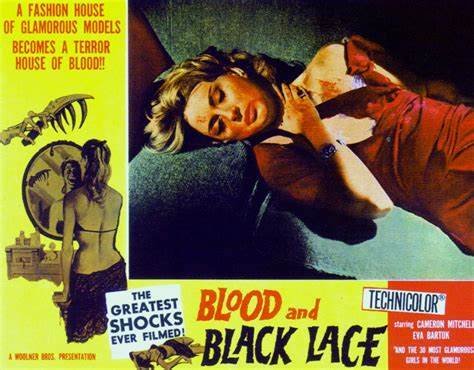
The archetypal giallo plot nearly always displayed a mysterious black gloved killer committing gruesome and imaginative murders with an accentuation on blood. The slayings were as merciless and savage as a face being forced onto a burning hot stove or ruthless multiple stabbings of bare female flesh. On the tail of the psychopathic murderer was usually a protagonist who finds themselves in unusual circumstances, who then in turn become a target as they attempt to solve the crime. Gialli began to be divided into two gendered categories, that of the male giallo and the female giallo. The male giallo is always centered on a male outsider or outcast who bears witness to a homicide and then takes on the responsibility of investigation. In the case of female gialli, the protagonist is, of course, a female who must grapple with her crumbling psyche whilst becoming entangled in a psycho-sexual game of cat and mouse. The murders carried out are grisly and violent, and occur usually when a victim is the most vulnerable (ie) when naked. The identity of the killer is then revealed at the dramatic climax of the film. Due to the emphasis on violence, sex and nudity, gialli were more often than not categorized as exploitation cinema and accused of being misogynist.
Style Over Substance

With Italian filmmakers using the giallo as a way of flaunting their cinematic talent, the visual style of the films became superior to any sort of cohesive storyline. The cinematography was strongly technical, boasting unusual camera angles, that often took on a degree of voyeurism with it’s first person perspective cinematography during the brutal murder scenes. Close up of eyes and other random objects were utilized to create striking and unsettling shots, adding to a frantic atmosphere. Composition of scenes were disorientating, leaning on the influence of the psychedelia of the 1960s, married with anxiety inducing jazz music, causing the giallo to become an equal parts visual and aural immersive experience for audiences.
Despite its black and white origins in films such as Bava’s The Girl Who Knew Too Much and The Possessed (1965) directed by Luigi Bazzoni and Franco Rosselini, the giallo’s use of colour became paramount to its tell-tale characteristics. With the use of rich leafy greens, vibrant and lurid pinks and of course red- the colour of passion, danger and blood- the giallo became a feast for the visual senses. The application of vivid technicolour was a mechanism to further emphasize the shock factor encased within the giallo’s plot and served to unsettle audiences of the spaghetti thriller.
By the close of the 1960s, the giallo genre of horror was beginning to swell in popularity. Following the success of Bava’s Blood and Blacklace, Italian directors began to produce their own gialli, remarking on the ever changing flair within Italian fashion and popular culture, as well as the altering state of traditional gender roles within Italy’s society. 1968 saw the release of Antonio Margheriti’s The Young, The Evil and The Savage (Nude….si muore) and Massimo Dallamano’s A Black Veil For Lisa (La Morte Non Ha Sesso), From 1969, the giallo genre rapidly began to soar in popularity with Umberto Lenzi releasing three gialli in one year: Orgasmo, Paranoia and So Sweet, So Perverse (Cosi Dolce..Cosi Perversa) and the infamous Lucio Fulci directing One On Top Of The Other (Una Sull’altra) also in 1969. Yet it was a young Italian screenwriter, directing his first feature length that catapulted the giallo genre into becoming a major cultural phenomenon in the decade to come.



RELATED ARTICLES
![[Editorial] In Her Eyes: Tasya Vos in Possessor (2020)](https://images.squarespace-cdn.com/content/v1/5fe76a518d20536a3fbd7246/1667061747115-NTIJ7V5H2ULIEIF32GD0/Image+1+%285%29.jpg)
![[Editorial] In Her Eyes: Sara Lowes in Witchfinder General (1968)](https://images.squarespace-cdn.com/content/v1/5fe76a518d20536a3fbd7246/1655655953171-8K41IZ1LXSR2YMKD7DW6/hilary-heath.jpeg)
![[Editorial] The Babadook (2014)](https://images.squarespace-cdn.com/content/v1/5fe76a518d20536a3fbd7246/1651937631847-KR77SQHST1EJO2729G7A/Image+1.jpg)
![[Editorial] In Her Eyes: Helen Lyle in Candyman (1992)](https://images.squarespace-cdn.com/content/v1/5fe76a518d20536a3fbd7246/1649586854587-DSTKM28SSHB821NEY7AT/image1.jpg)
![[Editorial] Lorraine Warren’s Clairvoyant Gift](https://images.squarespace-cdn.com/content/v1/5fe76a518d20536a3fbd7246/1648576580495-0O40265VK7RN03R515UO/Image+1+%281%29.jpg)
![[Editorial] Sara in Creep 2 (2017)](https://images.squarespace-cdn.com/content/v1/5fe76a518d20536a3fbd7246/1646478850646-1LMY555QYGCM1GEXPZYM/27ebc013-d50a-4b5c-ad9c-8f8a9d07dc93.jpg)
![[Editorial] Sally Hardesty in The Texas Chainsaw Massacre (1974)](https://images.squarespace-cdn.com/content/v1/5fe76a518d20536a3fbd7246/1637247162929-519YCRBQL6LWXXAS8293/the-texas-chainsaw-final-girl-1626988801.jpeg)
![[Editorial] Margaret Robinson: Hammer’s Puppeteer](https://images.squarespace-cdn.com/content/v1/5fe76a518d20536a3fbd7246/1630075489815-33JJN9LSGGKSQ68IGJ9H/MV5BMjAxMDcwNDI2Nl5BMl5BanBnXkFtZTcwOTMxODgzMQ%40%40._V1_.jpg)
![[Editorial] Re-assessing The Exorcist: Religion, Abuse, and The Rise of the Feminist Mother.](https://images.squarespace-cdn.com/content/v1/5fe76a518d20536a3fbd7246/1629995626135-T5K61DZVA1WN50K8ULID/image2.jpg)
![[Editorial] Unravelling Mitzi Peirone’s Braid (2018)](https://images.squarespace-cdn.com/content/v1/5fe76a518d20536a3fbd7246/1628359114427-5V6LFNRNV6SD81PUDQJZ/4.jpg)
![[Editorial] American Psycho (2000)](https://images.squarespace-cdn.com/content/v1/5fe76a518d20536a3fbd7246/1627317891364-H9UTOP2DCGREDKOO7BYY/american-psycho-bale-1170x585.jpg)












EXPLORE
![[Editorial] 9 Essential Hagspolitation Horror Films and Where to Stream Them](https://images.squarespace-cdn.com/content/v1/5fe76a518d20536a3fbd7246/1770475320934-ABFCNG7QZCG95DHZW2TH/Hagsploitation+list.jpeg)
![[Editorial] 7 Valentine's Day films for the horror lover in your life](https://images.squarespace-cdn.com/content/v1/5fe76a518d20536a3fbd7246/1771008023919-TKX6A1Y1GKGQ20ONPNYD/nekromantik.jpg)
![[Editorial] Seven Horror Hits That Haunted Our Hiatus](https://images.squarespace-cdn.com/content/v1/5fe76a518d20536a3fbd7246/1769674801188-7W482NENPO0GN4CDHV5N/7+HORROR+HITS+HIATUS.webp)
![[Editorial] Oscar Nominations 2026: Where to stream all the horror picks](https://images.squarespace-cdn.com/content/v1/5fe76a518d20536a3fbd7246/1769113319180-4INRRNMZK4DZLHRSUXX5/rev-1-GRC-TT-0026r_High_Res_JPEG-1024x372.jpeg)
![[Editorial] 10 Films & Events to Catch at Soho Horror Film Fest 2023](https://images.squarespace-cdn.com/content/v1/5fe76a518d20536a3fbd7246/1700819417135-299R7L4P0B676AD3RO1X/Screenshot+2023-11-24+at+09.41.52.png)
![[Editorial] 9 Horror Nintendo Switch Games To Play](https://images.squarespace-cdn.com/content/v1/5fe76a518d20536a3fbd7246/1697214470057-3XZXX8N4LYIMDFWS6Z3P/Screenshot+2023-10-13+at+17.20.13.png)
![[Mother of Fears] Mothering in Silence in A Quiet Place (2018)](https://images.squarespace-cdn.com/content/v1/5fe76a518d20536a3fbd7246/1696445921315-HZJ2DZYQIH6VVWXBO2YL/Screenshot+2023-10-04+at+19.52.29.png)
![[Editorial] 5 Female Focused Horror Book Recommendations](https://images.squarespace-cdn.com/content/v1/5fe76a518d20536a3fbd7246/1696441981361-52EQCTJ7AT2QF1927GM7/919xtm6d3fL._AC_UF894%2C1000_QL80_.jpg)

![[Film Review] Redux Redux (2025)](https://images.squarespace-cdn.com/content/v1/5fe76a518d20536a3fbd7246/1772709237214-NWJO8S5RA2RI5KHGBDRP/Redux+Redux+%28Blue+Finch+Film+Releasing%29+%2801%29.jpg)
![[Film Review] The Convenience Store (2026)](https://images.squarespace-cdn.com/content/v1/5fe76a518d20536a3fbd7246/1772706929814-S9SCNO48X7OAAUXDGW6Z/%5Bmain%5DDSC07956+%281%29.jpg)
![[Film Review] Red Riding (2026)](https://images.squarespace-cdn.com/content/v1/5fe76a518d20536a3fbd7246/1772815841313-70WFC6UZR8R3D8K1QQNB/Red_Riding_MASTER_310725_4KDCI_PRORES4444.00_07_53_05.Still012.png)
![[Film Review] Queens of the Dead (2025)](https://images.squarespace-cdn.com/content/v1/5fe76a518d20536a3fbd7246/1772708277363-T21QMHC11OQWUEWE9JRA/Queens+of+the+Dead+%281%29.jpg)
![[Film Review] Bury the Devil (2026)](https://images.squarespace-cdn.com/content/v1/5fe76a518d20536a3fbd7246/1772707319010-7HUFW2VLHJ5RKZ3EH8C4/Bury+the+Devil_1.png)
![[Film Review] Jailbroken (2026)](https://images.squarespace-cdn.com/content/v1/5fe76a518d20536a3fbd7246/1771753986825-4CM6ZCTLWAZYUGB1IBMP/Jailbroken+%C2%A9+2026+Jailbroken+Film%2C+Ltd.+All+Rights+Reserved.jpg)
![[Film Review] Iron Lung (2026)](https://images.squarespace-cdn.com/content/v1/5fe76a518d20536a3fbd7246/1772663006181-UCSTWEIJZBJRNR97BJR9/Screenshot+2026-03-04+at+22.10.26.png)
![[Book Review] Tradwife (2026)](https://images.squarespace-cdn.com/content/v1/5fe76a518d20536a3fbd7246/1772486876449-UAV7VIO5G32H0EKC2Y1B/Trad+Wife+HB.jpg)
![[Film Review] God of Frogs (2026)](https://images.squarespace-cdn.com/content/v1/5fe76a518d20536a3fbd7246/1771753462812-RMBUZ03KIFVMFHVATZCR/GOF_ch1_still07.png)

Sed purus sem, scelerisque ac rhoncus eget, porttitor nec odio. Lorem ipsum dolor sit amet.