
[Film Review] Titane (2021)
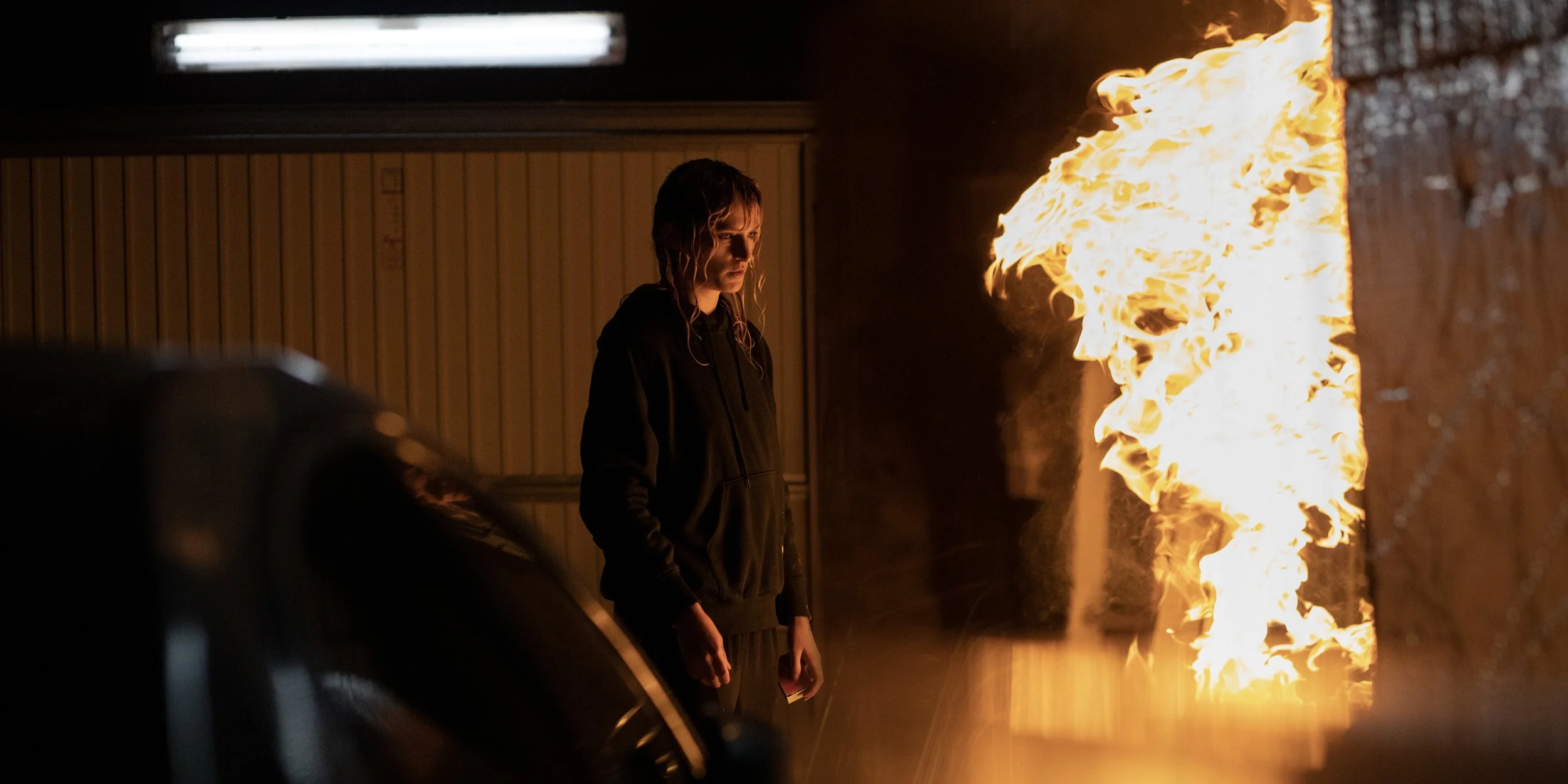
The striking and challenging new film Titane was written and directed by Julia Ducournau; and when I left the screening last night I felt as though the challenge is as much for us critics as it is for the wider audience. How can I possibly review this film? It’s left me frenzied with feelings, but unsure how to express opinions. I can’t describe too much, because spoilers will surely dull its full-body impact. And it’s too soon to analyse it, when most people won’t be ready to join in a discussion just yet; besides, there’s a good chance the themes and messages I draw from it could be different to the next person. So I’ll give you my impression of Titane, made up of a little bit of all of those, and hope you get the chance to form your own too.
Titane is the story of Alexia (Agathe Rousselle, in her memorable feature debut), who suffers a serious head injury from a car accident at seven years old, and grows up with a titanium plate in her skull. After a brief prologue, we get to know her life twenty-five years later, which has been formed by a combination of her reaction to that childhood trauma and society’s expectations: she is both a very public person, dancing provocatively in car shows, and also very private, clinging to secret passions and practices. Titane is also the story of how Alexia puts that life behind her when it suddenly becomes unsustainable after another, more grown-up crisis. It’s about the transformations she goes through---some physical, some deliberate, some neither---and the connections she makes along the way.
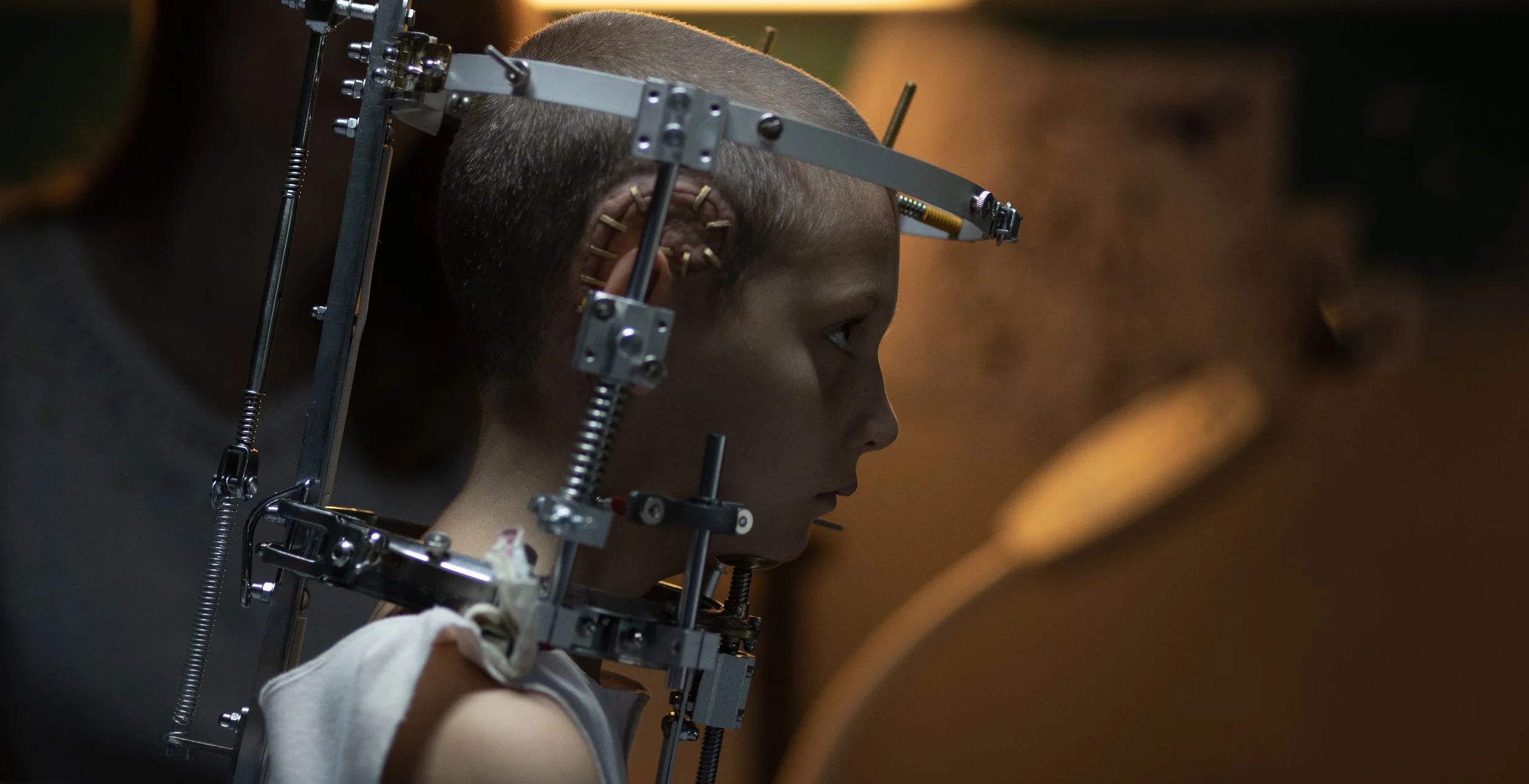
Oh and some might tell you it’s about cars. I wouldn’t put it like that. Instead, I’d say it’s a film of self-discovery and self-acceptance that features motor vehicles (and fire) quite heavily, just as Ducournau’s remarkable Raw was a coming of age film that featured the eating of human flesh as its major plot strand. Titane is no Fast and Furious though: this is not a testosterone-fueled piston-head’s wet dream, with muscles and car chases. As a survivor of a nasty car crash myself, I had been wary that the early scene might trigger some flashbacks but no (perhaps Baby Driver cured me of that), Ducournau does not dwell on the crash any longer than necessary, but instead goes straight to Alexia’s (admittedly graphic) surgery and her most unusual attraction to cars from then on. The credits sequence that moves fluidly over machine parts and then leads us to Alexia’s explosive dance makes it pretty damn clear that the feeling towards certain cars is an erotic one… but don’t worry, Titane doesn’t come with the masochism that ran through Cronenberg’s Crash, and according to Ducournau, the lead car in this film is female.
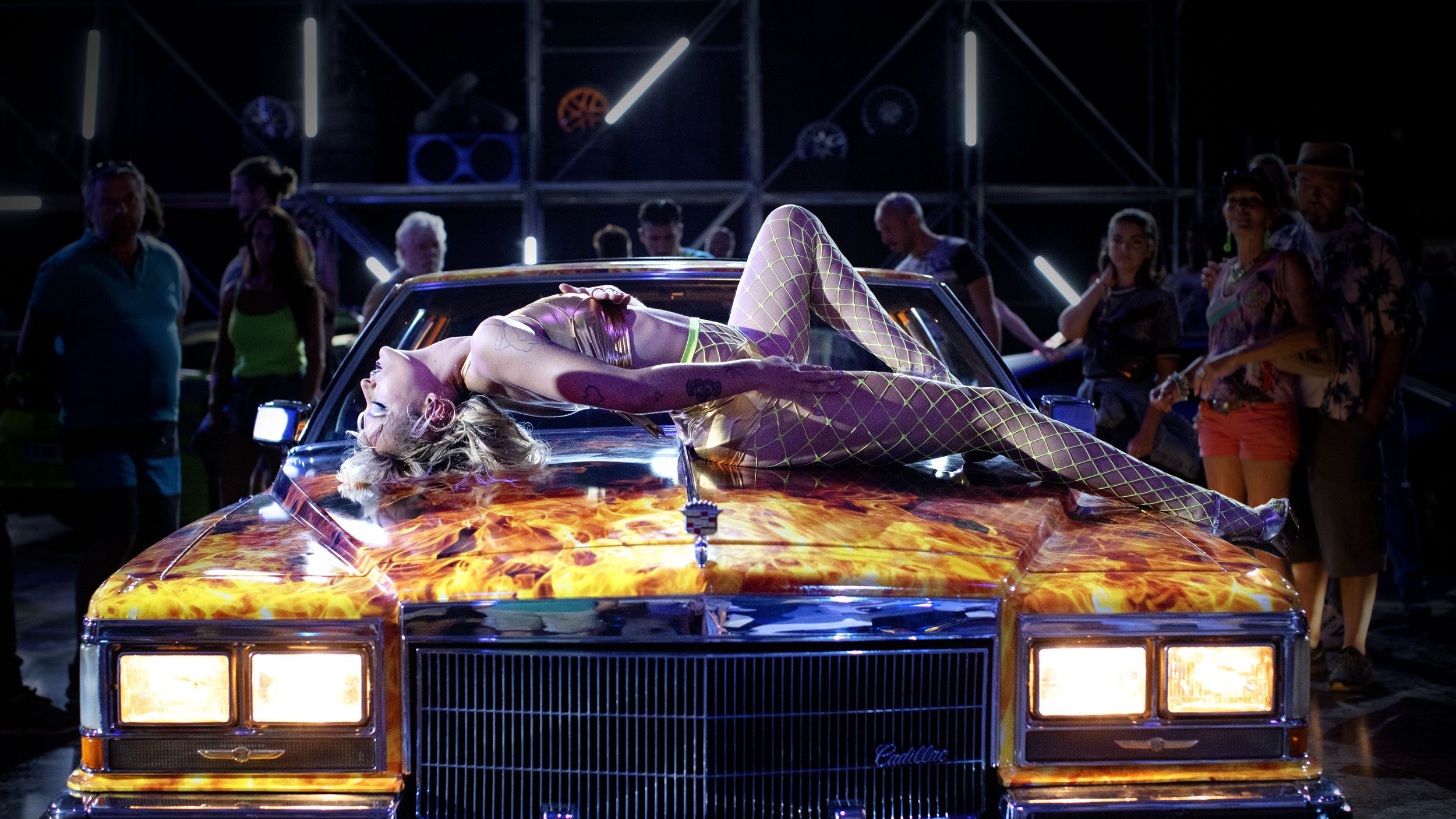
But back to Alexia. Agathe Rousselle is the true discovery of Titane (we already found out what a gem Ducournau is): it’s exciting to watch her blend innocence, fierceness, fragility and energy; in a less natural performer they would seem like a misguided combination. Maybe it’s the writing, though: a similar blend shines out from the secondary character, Vincent (Vincent Lindon), who I’ll return to shortly. Rousselle, though, seems to put everything into this part; not least her whole physical self: whether she is dancing, having sex, attacking, preparing for hiding, or indeed other activities which I’m not going to list, Rousselle uses and sometimes apparently abuses so much of herself to tell this story. She is incredible, and I really hope she feels proud of this performance. Funny, at times, her character reminded me of Pablo Larraín’s Ema (Mariana Di Girolamo), though unlike Ema, Alexia was not a particularly feminine woman. I don’t mean to say that she’s butch in any way (although there is a segment of the story in which she covers up her female body), but that she successfully discarded typically feminine traits and tropes. As a non-binary person myself, I loved seeing the way she didn’t feel the need to follow gender expectations, and the way her rejection of her gender allowed her to find new acceptance of her body and new acceptance from others.
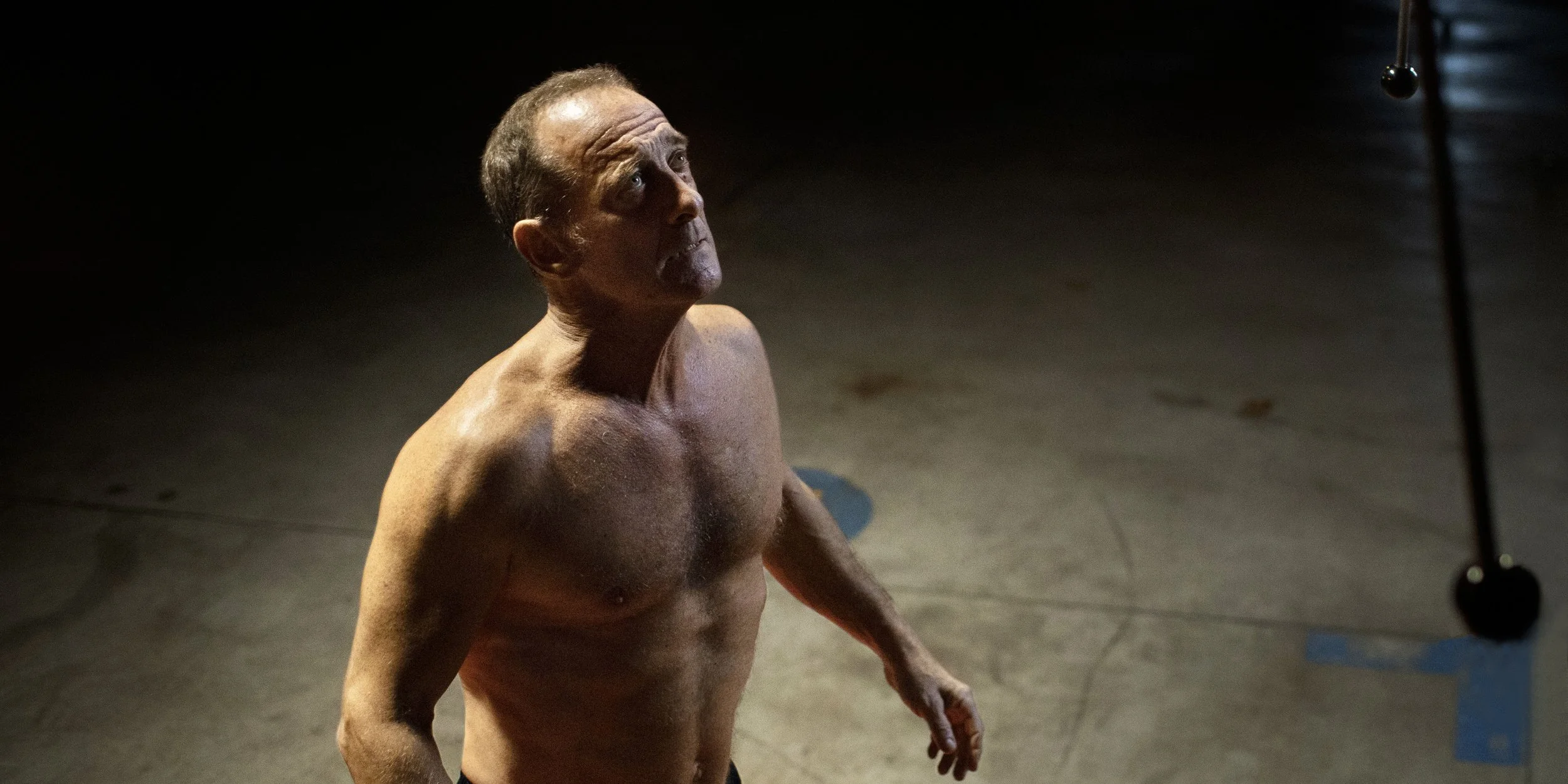
By “others” I’m referring really to Vincent, Alexia’s counterpart in the second half of Titane. Vincent is the middle-aged captain of a fire station, who brings Alexia into his world (albeit for his own misguided reasons), a naturally masculine environment. Privately, Vincent is also struggling with his own physical nature at this time, with age overtaking his evident machismo. The young troop of firefighters are also quite fascinating, some accepting and some making put-down jokes about the weird newcomer, but none aggressive or coarse.
There is, of course, more to a film than its cast; in Titane, a lot more. You might be wondering after everything I’ve written so far why this review is featured in a horror site, and in my opinion, what horror there is in Titane can be found in its visuals. People die, sure, but these deaths (and the satisfying use of a chair after one of them) don’t belong in a pedestrian thriller. I’ve seen a number of films in which pregnancy appears scarier than in real life, but this one comes with motor oil and raises a cigar to Tsukamoto’s Tetsuo: The Iron Man. Yet to me, Titane doesn’t feel like a horror film, any more than Lamb does: both put a natural occurrence just outside of reality in order to explore some real human concepts, like fairy tales do. And like many old fairy tales, this one is brutal.
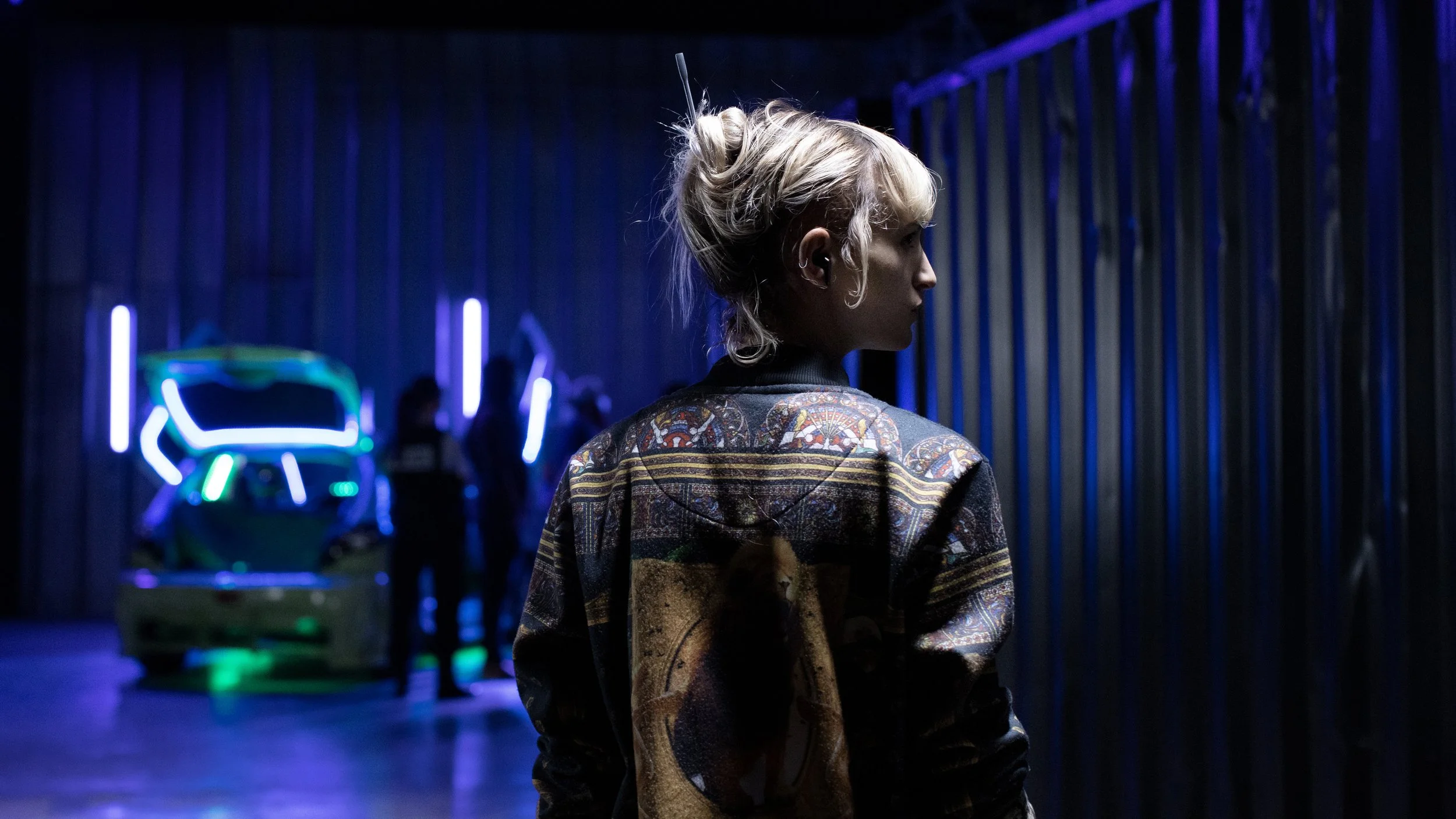
Titane had so much going on and so much to think about that I confess I didn’t take in much detail of the cinematography. I appreciated the urban gloss and the way the fantastical aspects of the story became so naturally woven in that they felt real, but not much more. Instead, I took in the vibrant use of music throughout the film. It has a strong original score from Jim Williams, but as well as that, there are several scenes which use dance and rock music of one kind or another to announce or lift the mood. Future Islands “Light House”, The Kills “Doing it to Death” and The Zombies “She’s Not There” (oh and a brief rave tune that no-one seems able to identify) all enhance pivotal moments in the film without smothering them.
Julia Ducournau’s direction is terrific in Titane, blending murder, arson, sci-fi, body horror and identity angst as though there’s really no reason why not. Granted, a lot of what appears on screen (and in my ears when I had to look away) is just over that line into extreme or simply way out; again, these reinforce the fairy tale mode as far as I’m concerned. But what really makes the film rich is the exploration of some deeply intimate themes – family, trauma, gender, identity – and the lovely use of fire to draw one in or to wipe out the obsolete. Not everyone who suffers a childhood trauma addresses it in a healthy way; indeed there are those who don’t acknowledge its influence at all until it consumes them. In Titane, Alexia has no choice but to acknowledge it at long last, and it’s freeing to discover what is there underneath.
Titane is released in cinemas on 31 December in the UK and Ireland, and I cannot wait to see it again.




RELATED ARTICLES
![[Film Review] Redux Redux (2025)](https://images.squarespace-cdn.com/content/v1/5fe76a518d20536a3fbd7246/1772709237214-NWJO8S5RA2RI5KHGBDRP/Redux+Redux+%28Blue+Finch+Film+Releasing%29+%2801%29.jpg)
![[Film Review] The Convenience Store (2026)](https://images.squarespace-cdn.com/content/v1/5fe76a518d20536a3fbd7246/1772706929814-S9SCNO48X7OAAUXDGW6Z/%5Bmain%5DDSC07956+%281%29.jpg)
![[Film Review] Red Riding (2026)](https://images.squarespace-cdn.com/content/v1/5fe76a518d20536a3fbd7246/1772815841313-70WFC6UZR8R3D8K1QQNB/Red_Riding_MASTER_310725_4KDCI_PRORES4444.00_07_53_05.Still012.png)
![[Film Review] Queens of the Dead (2025)](https://images.squarespace-cdn.com/content/v1/5fe76a518d20536a3fbd7246/1772708277363-T21QMHC11OQWUEWE9JRA/Queens+of+the+Dead+%281%29.jpg)
![[Film Review] Bury the Devil (2026)](https://images.squarespace-cdn.com/content/v1/5fe76a518d20536a3fbd7246/1772707319010-7HUFW2VLHJ5RKZ3EH8C4/Bury+the+Devil_1.png)
![[Film Review] Jailbroken (2026)](https://images.squarespace-cdn.com/content/v1/5fe76a518d20536a3fbd7246/1771753986825-4CM6ZCTLWAZYUGB1IBMP/Jailbroken+%C2%A9+2026+Jailbroken+Film%2C+Ltd.+All+Rights+Reserved.jpg)
![[Film Review] Iron Lung (2026)](https://images.squarespace-cdn.com/content/v1/5fe76a518d20536a3fbd7246/1772663006181-UCSTWEIJZBJRNR97BJR9/Screenshot+2026-03-04+at+22.10.26.png)










EXPLORE
![[Editorial] 9 Essential Hagspolitation Horror Films and Where to Stream Them](https://images.squarespace-cdn.com/content/v1/5fe76a518d20536a3fbd7246/1770475320934-ABFCNG7QZCG95DHZW2TH/Hagsploitation+list.jpeg)
![[Editorial] 7 Valentine's Day films for the horror lover in your life](https://images.squarespace-cdn.com/content/v1/5fe76a518d20536a3fbd7246/1771008023919-TKX6A1Y1GKGQ20ONPNYD/nekromantik.jpg)
![[Editorial] Seven Horror Hits That Haunted Our Hiatus](https://images.squarespace-cdn.com/content/v1/5fe76a518d20536a3fbd7246/1769674801188-7W482NENPO0GN4CDHV5N/7+HORROR+HITS+HIATUS.webp)
![[Editorial] Oscar Nominations 2026: Where to stream all the horror picks](https://images.squarespace-cdn.com/content/v1/5fe76a518d20536a3fbd7246/1769113319180-4INRRNMZK4DZLHRSUXX5/rev-1-GRC-TT-0026r_High_Res_JPEG-1024x372.jpeg)
![[Editorial] 10 Films & Events to Catch at Soho Horror Film Fest 2023](https://images.squarespace-cdn.com/content/v1/5fe76a518d20536a3fbd7246/1700819417135-299R7L4P0B676AD3RO1X/Screenshot+2023-11-24+at+09.41.52.png)
![[Editorial] 9 Horror Nintendo Switch Games To Play](https://images.squarespace-cdn.com/content/v1/5fe76a518d20536a3fbd7246/1697214470057-3XZXX8N4LYIMDFWS6Z3P/Screenshot+2023-10-13+at+17.20.13.png)
![[Mother of Fears] Mothering in Silence in A Quiet Place (2018)](https://images.squarespace-cdn.com/content/v1/5fe76a518d20536a3fbd7246/1696445921315-HZJ2DZYQIH6VVWXBO2YL/Screenshot+2023-10-04+at+19.52.29.png)
![[Editorial] 5 Female Focused Horror Book Recommendations](https://images.squarespace-cdn.com/content/v1/5fe76a518d20536a3fbd7246/1696441981361-52EQCTJ7AT2QF1927GM7/919xtm6d3fL._AC_UF894%2C1000_QL80_.jpg)

![[Editorial] In Her Eyes: Tasya Vos in Possessor (2020)](https://images.squarespace-cdn.com/content/v1/5fe76a518d20536a3fbd7246/1667061747115-NTIJ7V5H2ULIEIF32GD0/Image+1+%285%29.jpg)
![[Editorial] In Her Eyes: Sara Lowes in Witchfinder General (1968)](https://images.squarespace-cdn.com/content/v1/5fe76a518d20536a3fbd7246/1655655953171-8K41IZ1LXSR2YMKD7DW6/hilary-heath.jpeg)
![[Editorial] The Babadook (2014)](https://images.squarespace-cdn.com/content/v1/5fe76a518d20536a3fbd7246/1651937631847-KR77SQHST1EJO2729G7A/Image+1.jpg)
![[Editorial] In Her Eyes: Helen Lyle in Candyman (1992)](https://images.squarespace-cdn.com/content/v1/5fe76a518d20536a3fbd7246/1649586854587-DSTKM28SSHB821NEY7AT/image1.jpg)
![[Editorial] Lorraine Warren’s Clairvoyant Gift](https://images.squarespace-cdn.com/content/v1/5fe76a518d20536a3fbd7246/1648576580495-0O40265VK7RN03R515UO/Image+1+%281%29.jpg)
![[Editorial] Sara in Creep 2 (2017)](https://images.squarespace-cdn.com/content/v1/5fe76a518d20536a3fbd7246/1646478850646-1LMY555QYGCM1GEXPZYM/27ebc013-d50a-4b5c-ad9c-8f8a9d07dc93.jpg)
![[Editorial] Sally Hardesty in The Texas Chainsaw Massacre (1974)](https://images.squarespace-cdn.com/content/v1/5fe76a518d20536a3fbd7246/1637247162929-519YCRBQL6LWXXAS8293/the-texas-chainsaw-final-girl-1626988801.jpeg)
![[Editorial] Margaret Robinson: Hammer’s Puppeteer](https://images.squarespace-cdn.com/content/v1/5fe76a518d20536a3fbd7246/1630075489815-33JJN9LSGGKSQ68IGJ9H/MV5BMjAxMDcwNDI2Nl5BMl5BanBnXkFtZTcwOTMxODgzMQ%40%40._V1_.jpg)
![[Editorial] Re-assessing The Exorcist: Religion, Abuse, and The Rise of the Feminist Mother.](https://images.squarespace-cdn.com/content/v1/5fe76a518d20536a3fbd7246/1629995626135-T5K61DZVA1WN50K8ULID/image2.jpg)
![[Editorial] Unravelling Mitzi Peirone’s Braid (2018)](https://images.squarespace-cdn.com/content/v1/5fe76a518d20536a3fbd7246/1628359114427-5V6LFNRNV6SD81PUDQJZ/4.jpg)

Lorem ipsum dolor sit amet, consectetur adipiscing elit. Vestibulum id ligula porta felis euismod semper.